
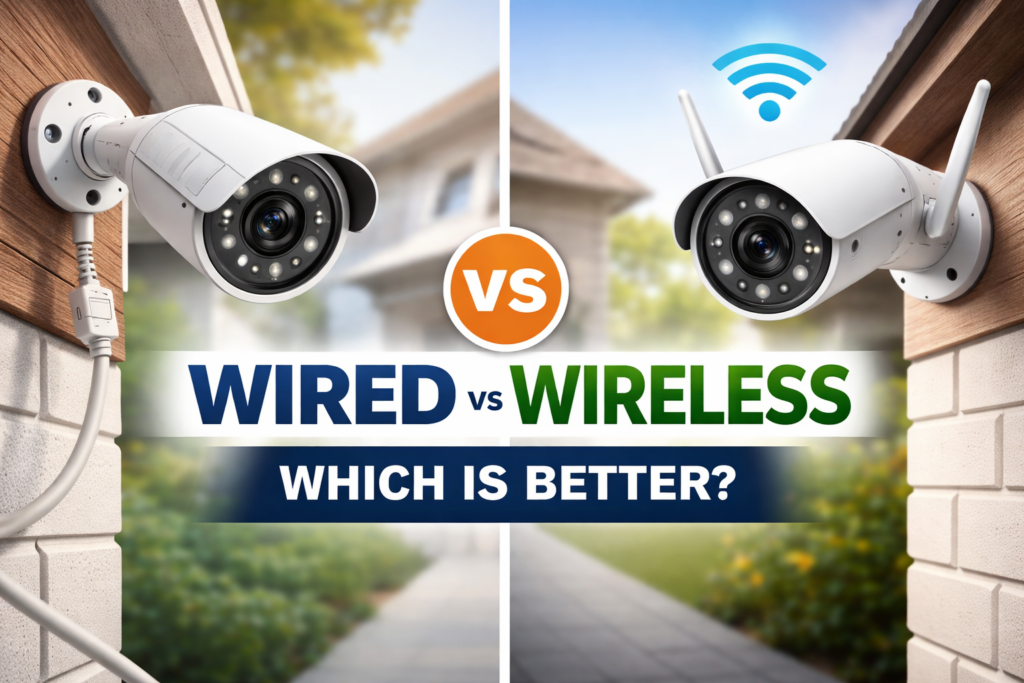
When homeowners first decide to install security cameras, the first real decision is not the brand or the price.
It’s this:
Should you choose wired cameras or wireless cameras?
Most people assume wireless is newer and therefore better. Others believe wired systems are the only reliable option. The truth is more practical.
The better choice depends less on the camera — and more on your house, your routine, and how you actually plan to use the system.
Both options can protect a home well.
But they solve different problems.
Let’s clearly understand the difference so you can choose correctly the first time.
What Is a Wired Security Camera? 🔌
A wired security camera connects to a recording device (DVR or NVR) using a physical cable.
The camera continuously sends video to that recorder inside your house.
This is the traditional professional installation type.
Advantages
✔ Very stable connection
✔ No WiFi signal problems
✔ Continuous recording
✔ No batteries to recharge
Disadvantages
❌ Installation requires running cables
❌ Harder to move later
❌ Usually installed once permanently
A wired system is closer to a recording system, not just a monitoring device.
What Is a Wireless Security Camera? 📶
A wireless camera connects to your home internet router instead of a cable.
You usually control it using a mobile app.
These are the cameras most homeowners buy online.
Advantages
✔ Quick installation
✔ Flexible placement
✔ Easy phone viewing
✔ Great for renters
Disadvantages
❌ Depends on WiFi quality
❌ Battery charging required (many models)
❌ May stop alerts if internet fails
Wireless systems behave more like a smart home device than a traditional security recorder.
Reliability Comparison
Here is the real difference homeowners experience.
| Situation | Wired Camera | Wireless Camera |
|---|---|---|
| Internet outage | ✔ Keeps recording | ❌ No alerts or remote view |
| Weak WiFi signal | ✔ Unaffected | ❌ May disconnect |
| Power outage | ❌ Stops unless battery backup | ❌ Stops unless battery |
| Long recording | ✔ Continuous | ⚠ Depends on storage/cloud |
💡 Important takeaway:
Wired cameras depend on electricity.
Wireless cameras depend on internet quality.
Neither is perfect — they fail in different situations.
Installation Difficulty
This is where the two systems feel very different.
Wired
- Requires drilling
- Running cables through attic or walls
- Usually a one-time installation
Better for:
🏠 homeowners
🏡 detached houses
Wireless
- Mount camera
- Connect to WiFi
- Install app
Better for:
🏢 apartments
🏠 renters
🚪 temporary setups
Many people choose wireless simply because installation is easier — not because it is better security.
Cost Over Time 💰
Many homeowners only look at purchase price, but long-term cost matters.
Wired system
- Higher installation cost
- Almost no monthly costs
- Minimal maintenance
Wireless system
- Lower starting price
- Battery replacements
- Possible cloud storage subscription
After 2–3 years, wireless systems often cost similar or more than wired systems.
Which Is Better for Different Homes?
Small Apartment
Best choice → Wireless
- Easy setup
- No drilling
- Enough coverage
Townhouse
Best choice → Wireless or Hybrid
- WiFi usually strong
- Flexible camera placement
Detached House
Best choice → Wired or Hybrid
- Outdoor coverage needed
- Reliability more important
Large Property
Best choice → Wired
- Long distances
- Continuous recording necessary
A Practical Recommendation
Many professional installers now use a mixed approach:
Outdoor cameras → Wired
Indoor cameras → Wireless
Why?
Outdoor cameras prevent incidents.
Indoor cameras monitor activity.
This gives reliability without losing flexibility.
Conclusion
There is no universal “better” camera type.
Wireless cameras are convenient and fast to install.
Wired cameras are stable and reliable long-term.
If you want simplicity → wireless works well.
If you want consistent recording and fewer surprises → wired is stronger.
The best home security setup is the one that matches how your home is actually used — not just what looks modern.
Understanding your property layout matters more than choosing the newest device.