
Most homeowners make one of two mistakes:
• They install too few cameras → important areas stay unprotected
• Or they install too many → waste money and still miss the real entry points
Security cameras are not about covering space.
They are about covering access paths.
A burglar does not enter randomly. Almost every intrusion happens through predictable routes.
If you cover those routes correctly, 3–6 cameras usually protect a house better than 10 poorly placed ones.
This guide shows how to calculate the exact number logically.
Step 1: Count Entry Points
(This Determines 70% of Camera Count)
Walk around your house and count:
- Front door
- Back door
- Garage door
- Ground-floor windows reachable from outside
Every entry point should be visible from at least one outdoor camera.
Basic Rule
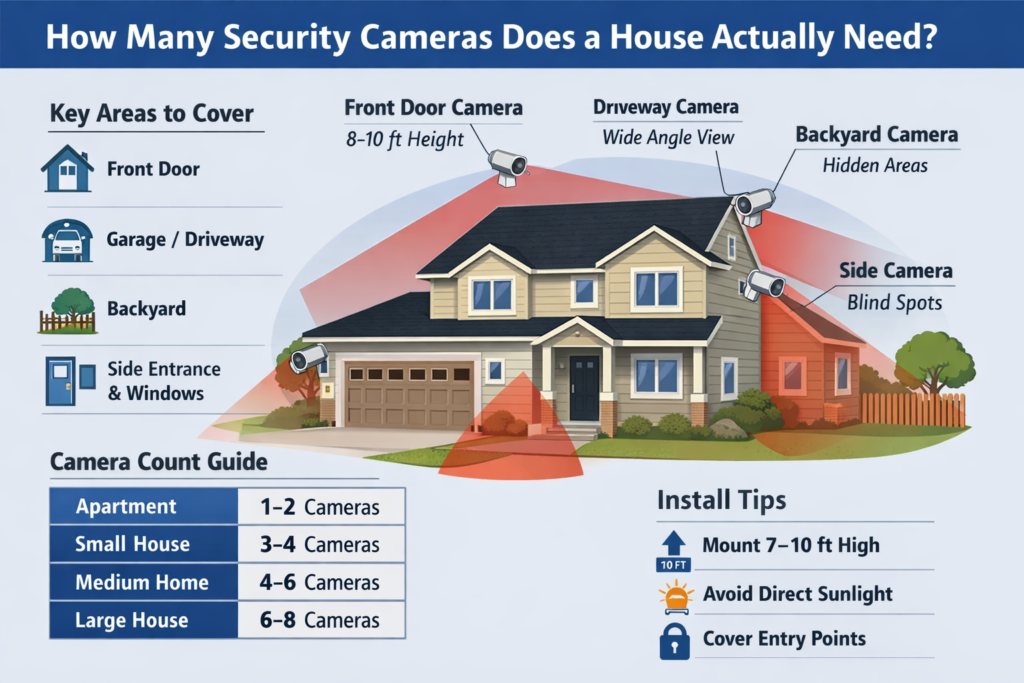
1 camera per major entry path
Typical result:
| Property Type | Entry Points | Minimum Cameras |
|---|---|---|
| Apartment | 1 | 1–2 cameras |
| Townhouse | 2–3 | 2–3 cameras |
| Small house | 3–4 | 3–4 cameras |
| Detached house | 4–6 | 4–6 cameras |
You already see why most homes do NOT need 8–12 cameras.
Step 2: The 5 Mandatory Coverage Zones
Regardless of house size, these locations matter far more than interior rooms.
1. Front Door (Highest Priority)
About 35% of package theft and forced entry happens here.
Camera position:
- Height: 8–10 ft (2.5–3 m)
- Angle: facing slightly downward
- Avoid pointing directly at the street (license plates won’t be readable anyway)
Tip: A doorbell camera alone is not enough — it records faces, not approach movement.
2. Driveway / Garage
This camera does three jobs:
• records vehicles
• detects strangers approaching
• captures activity before reaching the door
Best placement:
Above garage door or roof corner facing driveway.
This is often the most useful camera on the property.
3. Backyard / Rear Door
Burglars prefer the back of a house because:
- less lighting
- less visibility from neighbors
Many homes install indoor cameras but forget the back entrance — the most common mistake.
4. Side Path or Alley
If someone can walk along the side of your house unseen, you need coverage here.
A single side-mounted camera often prevents 80% of blind spots.
5. Ground-Floor Windows (only if accessible)
Not all windows need cameras.
Add coverage only if the window:
- is hidden from street view
- has bushes or fences nearby
- can be reached without a ladder
Step 3 — Indoor Cameras: Optional, Not Primary Security
Indoor cameras are not replacements for outdoor ones.
Outdoor cameras = prevention
Indoor cameras = evidence
Install indoor cameras only if:
- you have pets
- you want motion alerts when away
- you need to monitor children or elderly
Most homes only need 1 indoor camera (living room facing entrance hallway).
Step 4 — Calculate Your Final Number
Use this formula:
Number of Cameras = Entry Points + Blind Spots
Example:
Front door → 1
Back door → 1
Garage → 1
Side path → 1
Backyard → 1
Total = 5 cameras
This is why a typical single-family home ends up needing 4–6 cameras.
Common Placement Mistakes
Mounting too low
Below 7 ft → cameras get stolen or tampered with.
Facing direct sunlight
Morning or evening sun blinds the sensor.
Always mount under eaves or shade.
Pointing at neighbor’s property
Many US states have privacy rules.
Aim toward your property boundaries.
Relying only on motion detection
Cameras should monitor approach paths, not only movement zones.
Do You Need 360° Coverage?
No.
Security cameras are not CCTV surveillance systems.
You don’t need to watch every wall.
You only need to record approach → attempt → entry.
If those three are recorded, you achieved effective security.
Quick Recommendations by Home Type
Apartment → 1 door camera + optional indoor
Townhouse → front + rear = 2–3 cameras
Small house → 3–4 cameras
Typical suburban home → 4–6 cameras
Large property → 6–8 cameras
Anything above that is usually redundancy, not protection.